

Island Peak Climbing with Everest Base Camp Trek: 17-Day Ultimate Guide
- Nepal See on map
-
Duration 16 Nights/17 Days
-
Difficulty Moderate
-
Region EVEREST REGION
-
Activity PEAK CLIMBING
-
Max. Altitude 6189m
-
Group Size 1 People
Trek Overview
The Island Peak climb with Everest Base Camp trek is the most adventurous blend of regular Everest trekking with the mountain summit. It is the ultimate adventure for trekkers looking for a Himalayan mountaineering experience. This trek spans more than two weeks through Sagarmatha National Park in the Solukhumbu district. Guided by the expert support of Adventure Himalaya Nepal, you will gain the refined support and experience of the Khumbu region.
We will have a regular Everest Base Camp trek on the first phase. After exploring Everest Base Camp and Kala Patthar, we will follow the Chhukung trail to catch Island Peak. This itinerary is systematically prepared for the extreme elevation. The itinerary has two built-in acclimatization days and numerous short trekking days for the trekkers to adjust to the thinning air. The climb requires licensed IFMGA/NNMGA-certified Sherpa guides to lead the climb, ensuring the highest mountain safety protocols, fixed-rope rigging, and technical oversight.
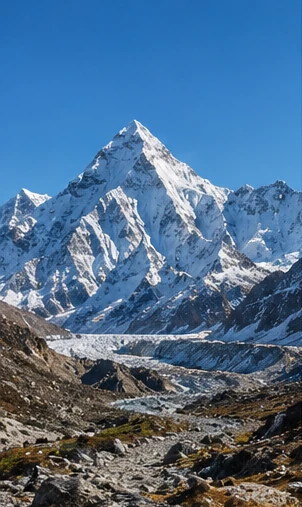
The Island Peak is graded as an Alpine PD+ climb. It is technically accessible to the ambitious novices with great physical fitness and health. This peak is used as a warm-up climbing experience by the Everest expedition teams. Island Peak offers real mountaineering challenges, including navigating glacier moraines, ascending a 45-degree headwall, and crossing an exposed summit ridge. The real reward of the Island Peak summit is an unmatched 360-degree panorama of Lhotse, Nuptse, Ama Dablam, and Makalu.
Apart from the summit push, this trek delivers us deep cultural immersion through ancient Sherpa heritage. We will see high-altitude trading in Namche Bazaar and the spiritual capital at Tengboche Monastery. Adventure Himalaya Nepal invites everyone who wants to embark on this beautiful adventure. Our professional support will help you embark on the Island Peak and Everest Base Camp trek seamlessly.
Major Highlights: Island Peak and Everest Base Camp Trek
- Complete an exhilarating Himalayan mountaineering expedition, tackling glacial traverses and fixed-line ascents on the steep headwall.
- The trek to Everest Base Camp will be a triumphant moment as it is the most renowned trekking achievement.
- Kala Pathhar Sunrise Viewpoint provides the famous and unmatched panoramic views of Mt. Everest, Nuptse, Changtse, and Pumori.
- We will use the full Everest Base Camp acclimatization days in Namche and Dingboche to ensure we have enough energy left for the Island Peak summit.
- We will gain some practical technical skills at Island Peak base camp by using the equipment taught by expedition guides.
- We will explore the rich local culture throughout the trek in Namche, Tengboche, Dingboche, and many more.
- The spiritual serenity of Tengboche Monastery will be one for the lifetime, as it is the largest Tibetan-Buddhist monastery in the Khumbu region.
- We will experience the dramatic sights throughout Sagarmatha National Park, helping us to capture magnificent pictures etched in our memories.
Why Combine Everest Base Camp Trek with Island Peak Climbing?
The Island Peak climbing with Everest Base Camp trek is one of the most definitive adventures that combines Nepal’s most iconic high-altitude journey with a mountaineering ascent. This trek offers us a balance of classic Himalayan exploration and natural physiological acclimatization. We will achieve two lifetime milestones within a single, highly efficient 18-day expedition through the majestic Khumbu region.
- We will bag the legendary Everest Base Camp trek and conquer an authentic 6,000-meter Island Peak in a single trip.
- We will trek the full base camp circuit while naturally conditioning our bodies to the thinning air.
- Island Peak is an accessible mountaineering stepping stone, often used as the warm-up climb before the Everest Expedition missions.
- The knife-edge summit ridge of Island Peak will provide the unrivaled 360-degree amphitheater views, including Lhotse, Nuptse, Makalu and Ama Dablam.
Travelling with Adventure Himalaya Nepal
Travel with Adventure Himalaya Nepal Pvt Ltd., ensuring your journey is supported by exceptional service, local expertise, and trusted safety standards, encouraging confidence in booking.
We offer more than trekking, including tours, mountain flights, city guides, and more. We handle all the demanding logistics to make your first-hand experience better and sweeter with Adventure Himalaya Pvt. Ltd. You can have a great experience visiting Nepal. Because visiting Nepal just once is not enough.
Major Attractions: Island Peak and Everest Base Camp Trek
Island Peak Summit Ridge (6,189 m)
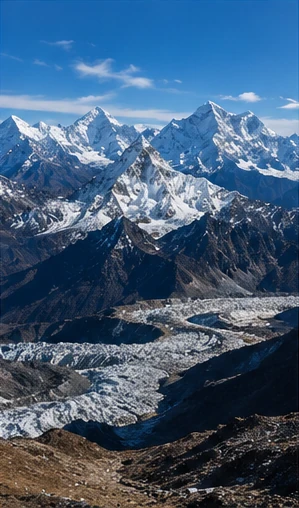
The climax of the climb to the summit of Island Peak (Imja Tse). After a spectacular technical climb on a steep glacial headwall on fixed ropes, we reach a knife-edge snow ridge from which an unparalleled view opens up to the main Everest massif. From this vantage point on the summit ridge of the mountain, we have a magnificent view of the great Himalayan giants, giving us a unique insight into the heart of the Everest region. We also overlook the huge Southern Face of Lhotse (8,516 m), along with Makalu, Nuptse, and Baruntse.
Everest Base Camp (5,364 m)
The most spectacular Everest experience starts with an exciting approach to Everest Base Camp (EBC). This place sits on the moving moraine of the famous Khumbu Glacier at an altitude of 5,364 meters above sea level. Here, you can see the fascinating spectacle of the icefalls of the Khumbu Glacier up close and personally experience the atmosphere of high-mountain climbing. Surrounded by the towering rock formations of Pumori, Lingtren and the ice towers of Khumbutse, the EBC is one of the most sought-after Himalayan destinations in the world.
Kala Patthar Sunrise Viewpoint (5,545 m)
While the Base Camp is located under the massif of Everest, Kala Patthar offers the most unobstructed view of the summit of Mount Everest (8,848.86 m). This viewpoint offers incomparable photo opportunities and unforgettable insights into the heart of the Everest massif. In the early morning hours of the climb, hikers are rewarded with a view of the golden morning sun shining over the black pyramid of Everest, the Nuptse Wall, and the snow-covered peak of Changtse. In addition, the high altitude (5,545 m) will help with acclimatization for the upcoming assault on the summit of Island Peak.
Tengboche Monastery (Dawa Choling Gompa)
Perched on a rocky spur at an altitude of 3,860 meters, the Tengboche Monastery represents the spiritual center of the Khumbu region. Surrounded by dramatic Himalayan peaks, this sacred complex feels mystical. Beautifully decorated monasteries, traditional Tibetan prayer wheels, and the deep, echoing chants of monks greeting the morning sun create an unforgettable photo backdrop. The ancient stone buildings of the monastery complex are complemented by the view of the towering Ama Dablam peaks and the alpine rhododendron forests of Sagarmatha National Park.
Namche Bazaar: The Sherpa Capital (3,440 m)
Perched on a natural mountain amphitheater, this Sherpa village is both a crossroads of ancient trade routes and a popular stop for modern-day adventurers. The authentic alpine architecture of traditional Sherpa houses creates a charming backdrop for a unique Himalayan experience. Here, you will find not only souvenir shops and bakeries, but also excellent opportunities for rest and acclimatization to altitude. Thus, Namche Bazaar plays a key role in this trekking program as a base for exploring the Everest region, offering hikers the opportunity to ascend to the Everest View Hotel while descending to spend the night in comfortable local accommodations.
Day-by-Day Itinerary Overview
We will begin the Island Peak climbing with the Everest Base Camp Trek with a scenic flight to Tenzing-Hillary Airport in Lukla. This airstrip is the primary gateway for Himalayan trekking. We will meet our licensed Sherpa guides and porters before we initiate the gradual descent through lush pine forests. We will cross some sturdy suspension bridges adorned with the prayer flags. We will reach Phakding by lunch. We will settle in a teahouse in Phakding for the rest of the day.
We will trek upstream along the riverbanks of the Dudhkoshi River. We will enter Sagarmatha National Park at the Monjo checkpoint. We will have our permits checked here before we cross the iconic Hillary suspension bridge with the picturesque views of Ama Dablam. We have to encounter the stretch of ascent to reach Namche Bazaar with the introductory views of Mt. Everest. We will reach the vibrant mountain amphitheater of Namche Bazaar. Overnight in a teahouse.
We will spend an acclimatization day as part of our itinerary. This day is essential for preventing altitude sickness. We will spend this active rest day exploring the highest hotel in the world, Hotel Everest View at 3800m. The hotel’s balcony is renowned for the sweeping views of Everest and neighboring peaks. Descend to Khumjung village to visit the local monastery, which houses the claimed yeti scalp, and the Hillary School. Return to Namche and spend the rest of the day exploring Namche Bazaar. Overnight in a teahouse.
We will follow a high-contour trail with some of the best views across Imja Khola gorge before descending steeply to Phunki Tenga for lunch. From the riverside, we will begin a sustained climb through shaded birch and conifer forests. We reach the ridge-top settlement of Tengboche, home to the famous Tengboche Monastery. Trekkers often attend the chanting ceremonies against the famous Ama Dablam backdrop. Overnight in a teahouse.
We will descend through the peaceful alpine forests from Tengboche in the morning. We cross the rushing Imja Khola via a suspension bridge. The tree line will give way to rugged alpine shrub and tundra as we ascend past the ornate chortens of Pangboche. We continue along the windswept valley floor, skirting the base of towering peaks toward Pheriche. This high-altitude valley settlement is home to the Himalayan Rescue Association(HRA) medical post. Overnight in a teahouse in Pheriche.
We will take another acclimatization day in Pheriche. This day is vital before we enter the extreme alpine elevations. We will take an active acclimatization hike up the ridge that overlooks the Tsola Basin or towards Nangkar Tshang peak for dramatic vantage points. In the afternoon, we will attend an altitude awareness seminar with the Himalayan Rescue Association. The physicians will provide us with important tips about the management of altitude sickness. Overnight in a teahouse.
Trek across alpine meadows to Dhugla (Thukla). We will climb a steep, rocky moraine to Thoka Pass(4830m). Pay tribute to the departed souls at the Everest Memorial. The trail flattens slightly with the lateral moraine of the massive Khumbu Glacier. We will settle into an alpine lodge in Lobuche. The thinning air and sub-freezing night temperatures will indicate the Himalayan zone. Overnight in a teahouse.
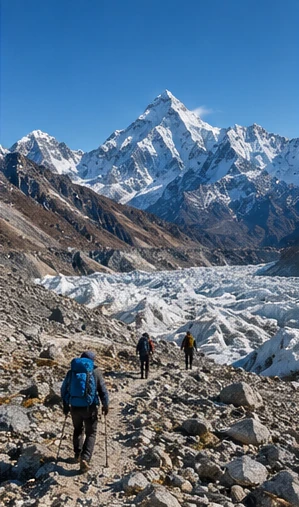
We will traverse the rough glacial scree and undulating moraines along the Khumbu Glacier to Gorak Shep. We will be dropping our heavy gear along the Khumbu Glacier to Gorak Shep. We will drop our heavy pack at the lodge. We will continue outward across the active glacier to reach Everest Base Camp (5,364 m/17,598 ft). We will celebrate our achievement beside the famous Base Camp Boulder. The moment will feel victorious, and we will celebrate with fellow trekkers and the crew. After celebrating, we will return to Gorak Shep for a well-deserved evening rest. Overnight in a teahouse.
We will begin a pre-dawn push to the steep slopes of Kala Patthar. We will reach the Kala Patthar viewpoint (5545m) by sunrise to see the most iconic sunrise view of Mt. Everest and Lhotse from the edges. After enjoying the sunrise, we will return to Gorak Shep for a hot breakfast. After breakfast, we will pack up to retrace our steps down the valley past Dughla and reach Dingboche. Overnight in Dingboche.
Today will be a deliberately short day. It is to preserve energy for the technical climb ahead. We will head east through the stone-fenced fields and moraine ridges of the Imja Valley. The sheer south face of Lhotse and the jagged spires of Island Peak will surround us. We will reach the small climbing outpost of Chhukung before noon. We will use the afternoon to inspect gear and fit crampons, harnesses, and mountaineering boots. We will also practice under the supervision of our expedition guide. Overnight in a teahouse.
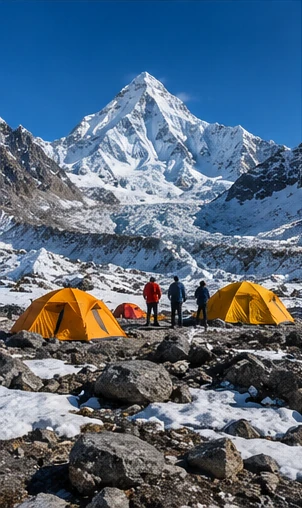
Today is a big day. We will set out along the southern flank of the moraine below Lhotse Glacier, following the rugged trail alongside the meltwaters of Imja Tsho Glacier Lake. We will ascend steadily to reach the Island Peak Base Camp. Pitch tents and settle into the camp life. In the afternoon, our climbing Sherpas will conduct a mandatory pre-climb briefing session and a refresher session. We will rest early to get enough rest before the climb day, overnight in a tent.
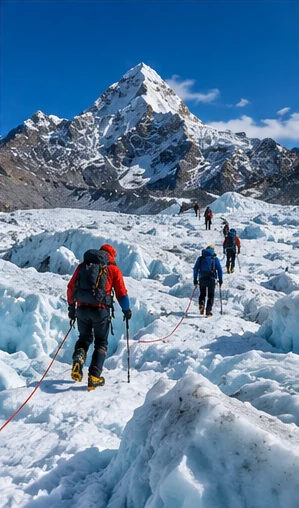
We will begin the summit push around 1:00 AM, navigating the steep, rocky scramble of Crampon Point before strapping on gear for the glacier traverse. Cross crevassed snowfields, negotiate ladders, and tackle the 45-degree ice headwall using fixed ropes and ascenders. Standing on the sharp summit ridge of Island Peak (6,189 m) rewards you with jaw-dropping views of Lhotse, Makalu, and Baruntse. After spending marvelous moments, we will return to base camp to pack and trek back to Chhukung.
We have taken this day as a contingency day to protect ourselves from the unpredictable Himalayan weather or personal acclimatization setbacks. If summit conditions were unfavorable the previous day, this day will provide us with a second opportunity to launch the attempt. If the climb was successful, we will get to explore more of Chhukung and the Khumbu region. Overnight in a teahouse in Chhukung.
We will begin a long descent back down the Imja Khola Valley. We will bypass the Dingboche and follow the lower path through the villages of Pangboche and Shomare. We will drop well below the treeline into thicker air, and breathing will also become easier. We will pass the historic Upper Pangboche Gompa, the oldest in the region. We will stop in Deboche for the night, reached after a stroll through the rhododendron forests.
We will climb gently back up the ridge to Tengboche Monastery for the final morning view of the mountain skyline. We will descend steeply through the forested switchbacks down to the river. We will cross the suspension bridge and climb the steady trail carved into the valley wall. We have to continue along the scenic high balcony trail that rebounds the ridge into Namche Bazaar. We will reach Namche Bazaar by evening and explore the town more. Overnight in a teahouse.
It is the final trekking day of our magnificent Island Peak Climbing with Everest Base Camp trek. We will descend steeply from Namche Bazaar down to the confluence of the Bhote Koshi and Dudh Koshi rivers. We will exit the Sagarmatha National Park and follow the riverside path through Phakding. Complete the final uphill from Phakding to Lukla, arriving in the evening. Gather and celebrate the successful trek with our Sherpa crew. Overnight in a teahouse.
Island Peak expedition story completes today. Board an early-morning twin-otter flight out of Lukla Airport, soaring past the Himalayan foothills on the breathtaking 35 to 40-minute journey back to Kathmandu (or Manthali/Ramechhap, depending on seasonal air traffic regulations). Upon arrival, transfer to your hotel in Thamel. Spend the rest of the day resting, enjoying a traditional massage, and shopping for authentic souvenirs, marking the successful completion of an unforgettable Everest Base Camp and Island Peak climbing expedition.
Are you looking to customize the trip itinerary?
If the provided schedule is not suitable for you, we can create a personalized travel arrangement tailored to your preferences and requirements.
Permits Required
| Permit / Fee | Issuing Authority | Price (USD / NPR) |
| NMA Island Peak Climbing Permit (Spring: Mar–May) | Nepal Mountaineering Association (NMA) | $250 USD / person |
| NMA Island Peak Climbing Permit (Autumn: Sep–Nov) | Nepal Mountaineering Association (NMA) | $125 USD / person |
| NMA Island Peak Climbing Permit (Winter / Summer) | Nepal Mountaineering Association (NMA) | $70 USD / person |
| Sagarmatha National Park Entry Permit | Department of National Parks & Wildlife Conservation | NPR 3,000 (~$23 USD) |
| Khumbu Pasang Lhamu Rural Municipality Permit | Local Government (Khumbu Municipality) | NPR 3,000 (~$23 USD) |
| Garbage Deposit Fee (Refundable) | Nepal Mountaineering Association (NMA) | $500 USD / team |
Note: Individual solo permits for peak climbs are not issued; climbs must be processed through a government-registered trekking agency with a licensed climbing guide.Adventure Himalaya Nepal will obtain all the permits as soon as you arrive in Nepal.
Special Gear and Equipment Required for Island Peak Climb
- Mountaineering Boots
- Crampons
- Climbing Harness
- Ice Axe
- Ascender (Jumar)
- Descender (Figure-8 or ATC)
- Locking & Regular Carabiners
- Slings
- Climbing Helmet
- Trekking Boots
- Camp Shoes / Down Booties
- Trekking & Summit Socks
- Liner Gloves
- Mid-weight Gloves
- Expedition Summit Mitts
- Thermal Base Layers
- Fleece Mid Layers
- Softshell Trekking Pants
- Insulated Summit Pants
- Waterproof Shell Jacket & Pants
- Expedition Down Parka
- Sun Cap
- Beanie
- Neck Gaiter
- Balaclava
- 4-Season Sleeping Bag (-20°C to -30°C)
- Duffel Bag (90–120L)
- Daypack (35–45L)
- Trekking Poles
- Category 4 Glacier Glasses
- Ski Goggles
- High-Lumen Headlamp & Spare Batteries
- Power Bank
- 1-Liter Wide-Mouth Water Bottles & Insulated Covers
- Sunscreen & Lip Balm
- First Aid Kit & Personal Medications
Best time for this trek
Spring Season (March to May): Warmer Climbs & Blooming Trails
Spring is one of the best windows and the premier time for the Island Peak climbing with the Everest Base Camp Trek. In fact, spring is the expedition season in Nepal. This season offers steadily warming daytime temperatures and elongated daylight hours. The lower trails through Sagarmatha National Park will burst into life with the blooming red, pink, and white of rhododendron and other wildflowers. Above the treeline, melting snowpack creates solid, compacted snow on the glacier route. Spring also brings longer daylight hours to helping us reach to our teahouses safely and explore. An added highlight of this trek is visiting Everest Base Camp at its busiest and liveliest time. The international mountaineering expeditions pitch colorful tents in spring. With Everest, Island Peak is also expected to have a busier base camp.
Autumn Season (September to November): Unrivaled Clarity & Stable Weather
Post-monsoon autumn stands as the peak and gold standard for the Himalayan mountaineering in the Khumbu region and all of Nepal. The summer rain will sweep the atmosphere clean and clear; trekkers will experience sharp, crystal-clear skies framing the mountains. The iconic mountain peaks like Everest, Lhotse, Nuptse, Ama Dablam, and neighboring peaks will shine like silver. The predictable weather patterns and stability will lower the risk of precipitation. We will have less possibility of drastic flight delays or cancellations than in other seasons. The nights will be cool and often sub-zero, but days will have dry and trekking-friendly conditions. Dashain and Tihar coincide this season, so expect more crowds on the regular Everest Base Camp trail.
Difficulties of the Trek
The main challenge of the Island Peak with Everest Base Camp trek is the extreme altitude. We will walk multiple days on the altitude of more than 4500 m, and the highest we will reach is 6189m at the summit of Island Peak. Such altitude can trigger acute mountain sickness, extreme cold, and sheer physical exhaustion from consecutive trekking days. We have to negotiate technical climbing, which is another hindrance for the novices. Overall, this trek is adventurous and full of challenges. A trekker will always require the help of a trekking guide and expedition guides.
Remedies to the Difficulties
- We will strictly adhere to the “climb high, sleep low” rule, maintain a daily hydration of 3-4 liters, and consult the doctor about prophylactic Diamox.
- We will attend the mandatory practical clinic at Island Peak Base Camp to dial in crampon footwork skills and learn figure-8 rappelling as preparation for the summit push.
- We will layer up with an expedition-rated down suit or heavy 800-fill down jacket, double mountaineering boots, windproof outer shells, and chemical hand/toe warmers for the summit night.
- We will follow a strict 12- to 16-week pre-trip cardio and strength training program focused on weighted stair climbs, zone-2 endurance, and pack-loaded hill hiking.
- We have to follow the itinerary with at least one or two buffer days to cater to the weather shifts.
Guides and Porters
At Adventure Himalaya Nepal, we offer certified and highly experienced licensed climbing Sherpas and local trekking guides to ensure the safety of every participant and help them achieve the summit. Our mountain guides are experts in glacier travel and fixing ropes for fixed-line climbing, and the hold qualifications such as NMA and IFMGA/NNMGA. On the day of the summit, they work with one to two climbers per guide.
Our Himalayan porters are the best part of our service. We are committed to responsible trekking and porterage and guarantee fair pay, insurance, warm clothing, and reduced loads for our porters. Each trekker should be aware that our guides carry only 20-25 kg per two people. Overall, the crew provides the necessary support so that the climber can concentrate only on conquering the highest point.
Teahouse Accommodations and Food
Throughout the Island Peak and Everest Base Camp trek, we will stay in the family-run teahouses. The teahouses along the route range from comfortable lodges in the lower altitudes to basic, arid teahouses at higher altitudes. Facilities are basic: twin-sharing or hall bedrooms, a common dining hall, and pit-style toilets without showers in the mountains. However, in the stops like Tengboche and Namche Bazaar, we will get good facilities compared to the teahouses at higher altitudes. Note that Island Peak Base Camp relies on tented camping with freshly prepared expedition meals.
Although the teahouses are basic, the menus are varied. The teahouses provide freshly cooked food centered on carbohydrate-rich dishes. The major serving is Dal Bhat. Alongside Dal Bhat, the menu includes pasta, porridge, eggs, momos, and noodle-based soups. We recommend that you to stick to the vegetarian meals above Namche, citing the digestion and freshness issues.
Travel Insurance
Comprehensive travel insurance is mandatory for Island Peak and Everest Base Camp expedition. The local operators and trekking agencies in Nepal will not grant you a climbing permit without proof of coverage, including us at Adventure Himalaya Nepal.
At high altitudes, emergencies such as HAPE, HACE, or a fall are not uncommon, and the ground rescue is not always an option. In the case of an emergency, helicopter evacuation in the Khumbu area can easily cost you $3,000 to $5,000 and has to be paid on the spot if a local operator demands it. Only a good insurer will cover this expense.
The standard travel insurance is not sufficient, as it usually only covers up to 3,000 meters and does not include any climbing or rope equipment. You need to take out a separate mountain and high-altitude insurance policy that covers:
- Trekking and technical climbing up to 6,500 m (Island Peak is 6,189 m)
- Unlimited helicopter evacuation and hospital treatment
- Technical equipment and gear, plus flight cancellation.
FAQs
The Everest Base Camp trek is purely non-technical, high-altitude hiking, but Island Peak is classified as an Alpine PD+ climb. It involves technical climbing along with the challenges like navigating glacier crevasses, snow slopes, and ascending a 45- 50-degree headwall using a jumar ascender. Another challenge is balancing along an exposed knife-edge summit ridge.
Yes. Beginner climbers can summit Island Peak. However, they need to be healthy, have strong cardiovascular fitness, and have prior multi-day trekking experience. Technical climbing experience isn't necessary. Older adults with cardiovascular health issues and children under 15 should not try this expedition.
Combining both routes provides the ideal acclimatization profile. Spending 9 to 10 days trekking through Namche, Dingboche, Gorak Shep, and summiting Kala Patthar (5,545 m) allows your red blood cells to adapt gradually. Climbing Island Peak directly without this build-up drastically increases the risk of Acute Mountain Sickness (AMS) and lowers summit success rates.
The summit day is a grueling 10-12 hour push. Summit day begins at around 1:00 AM to avoid midday melting and high wind tides. Climbers scramble up the rocky moraine by headlamp to Crampon Point and gear up for the glacier. We ascend the fixed-line headwall and reach the Island Peak summit around sunrise.
You need four distinct permits for the Island Peak and Everest Base Camp trek. :
NMA Island Peak Climbing Permit (issued by the Nepal Mountaineering Association).
Sagarmatha National Park Entry Permit.
Khumbu Pasang Lhamu Rural Municipality Permit.
Local garbage deposit fee
All the permits will be managed through Adventure Himalaya Nepal.
The best time for the Island Peak and Everest Base Camp trek is spring (March to May) and autumn (September to November). These seasons will provide the best and most predictable weather conditions, along with the buzzing environment.
A trekker should start training at least 12-16 weeks in advance to be physically ready for this climb. Focus on aerobic base-building (running, cycling, hiking, rowing). High-volume stair climbing and intense leg exercises are a must. You should also focus on eating at least 1.6g/kg of your body weight of protein every day during this period.
Yes. You can rent or purchase all technical gear. All the double mountaineering boots, crampons, harnesses, ice axes, helmets, and ascenders are available. You can find them either in Kathmandu (Thamel) or in the village of Chhukung right before Base Camp. Renting in Chhukung saves you from carrying heavy gear across the EBC trek. Adventure Himalaya Nepal will assist you with gear.
A comprehensive standard travel insurance is insufficient for the Island Peak climb with the Everest Base Camp Trek; you must carry specialized high-altitude mountaineering insurance. The insurance must cover trekking and climbing up to 6500m and unconditional emergency helicopter evacuation and medical treatment.
During the trek, you will stay in traditional teahouses featuring basic twin-sharing rooms and heated dining halls. At Island Peak Base Camp (and High Camp, if used), you will stay in four-season alpine tents managed by your expedition cook and Sherpa support crew.
Teahouses serve a high-carbohydrate diet, such as Dal Bhat, pasta, soups, and porridge. In the camps, the expedition crew will prepare hot cooked meals. Trekker will need to drink at least 3-4 liters of water daily to avoid low oxygen levels. Remember not to use plastic bottles and always use water purification tablets or buy boiled water at the lodge.
The guides carry pulse oximeters to monitor blood oxygen levels daily. Guides watch for even mild symptoms and recommend rest and medication if needed. If symptoms worsen into HAPE or HACE, the guide will arrange a helicopter rescue operation from Kathmandu.
The general rule for the Sherpa-to-climber ratio on Island Peak summit day is 1:2 or 1:1. A dedicated mountaineering guide will ensure personal safety on technical fixed lines, assist across crevasse ladders, and provide direct supervision.
A buffer day is essential for two reasons: absorbing unpredictable Lukla flight delays caused by mountain weather, and serving as a backup summit window if high winds or heavy snowfall prevent your climb on the scheduled summit day.
There are ATMs in Lukla and Namche Bazaar. But they are sometimes out of service. High-altitude teahouses accept Fonepay transactions in addition to cash. You must carry cash. We recommend that you to carry roughly 20-30 USD per day in cash. Cash will help you pay for non-inclusions like snacks, Wi-Fi cards, tips, etc.


